

Insect-scale robots get a brain upgrade through embodied intelligence
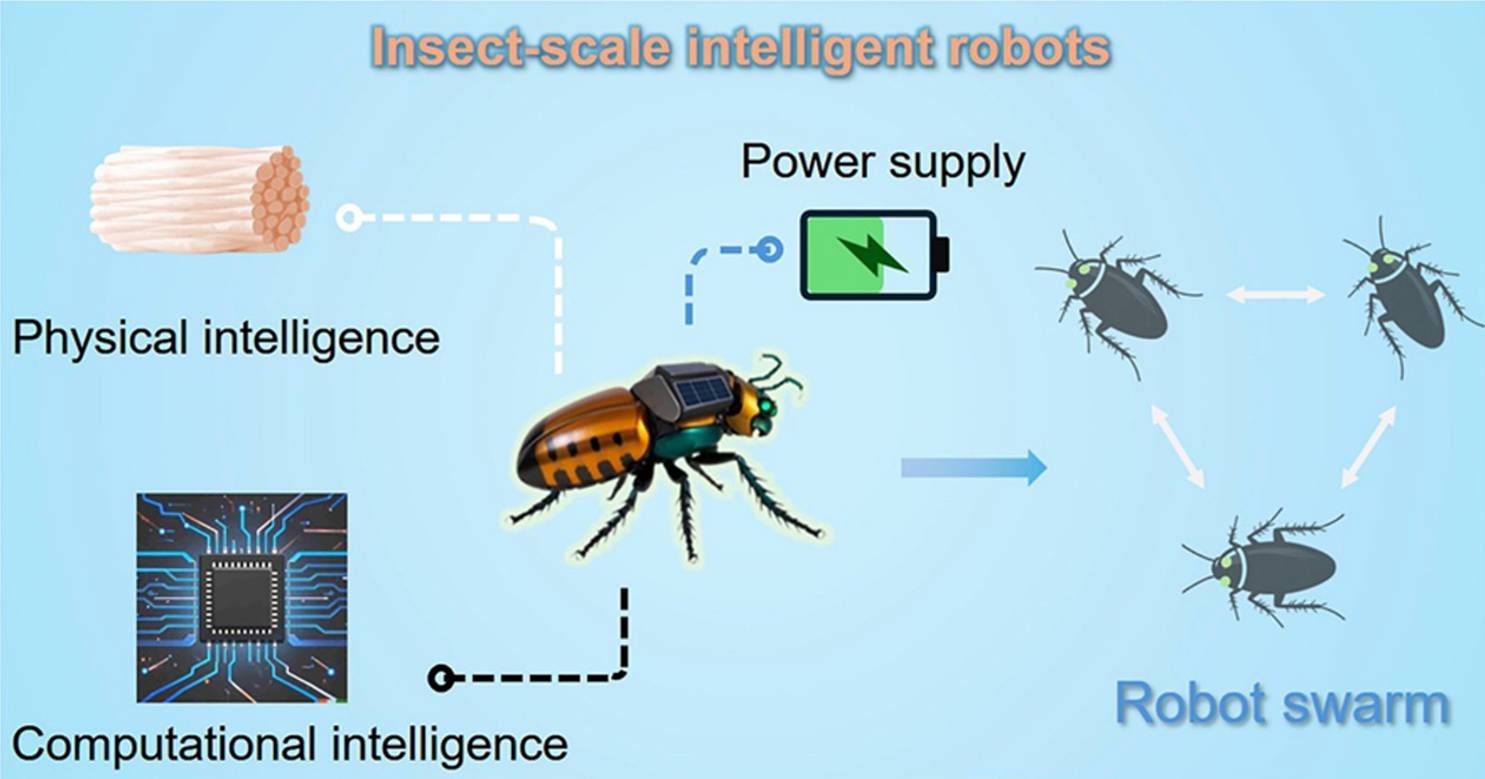
Components of embodied intelligence in insect‑scale robots.
GA, UNITED STATES, September 24, 2026 /EINPresswire.com/ -- Inspired by the agility and efficiency of insects, millimeter- to centimeter-scale robots hold enormous promise for environmental monitoring, search and rescue, and precision agriculture. But their tiny frames impose severe limits on payload, energy storage, and computing power—making true autonomy one of robotics' most stubborn challenges. A new perspective paper argues that the path forward lies not in squeezing more processing power onto smaller chips, but in "embodied intelligence"—a paradigm where smart, adaptive behaviors emerge from the seamless integration of a robot's physical form, materials, and environmental interactions.
The past decade has brought remarkable progress in insect-scale robotics: bio-inspired crawlers, swimmers, and fliers have demonstrated diverse locomotion capabilities. Soft materials like shape-memory alloys, dielectric elastomers, and liquid crystal elastomers enable large deformations and stimuli-responsive behaviors. Novel powering methods—from chemical fuels to biofuel cells—have been proposed to keep these tiny machines running. Yet none of these engineering breakthroughs have fully resolved the critical problem of achieving autonomous, adaptive behavior in unstructured, unpredictable environments. Due to these persistent challenges, an in-depth investigation into how physical form and computational strategy can be co-designed is urgently needed.
Now, a team of researchers from the University of Macau's Department of Electromechanical Engineering and Centre for Artificial Intelligence and Robotics has published (DOI: 10.1016/j.esci.2026.100549) a comprehensive perspective on this very question. In the journal eScience (Volume 6, Issue 4, July 2026), the team lays out a roadmap for achieving embodied intelligence in insect‑scale robots—charting a course from laboratory prototypes to practical, intelligent systems.
The paper dissects the problem across three interconnected levels. At the physical level, the authors advocate for "physical intelligence"—where smart materials, adaptive structures, and bio-inspired morphologies do the heavy lifting with minimal computation. Origami and kirigami structures can transform flat sheets into complex 3D shapes; multi-stable mechanisms can store elastic energy and enable self-adjusting behaviors without continuous external input; and bionic bodies with passive, compliant joints can navigate rough terrain without real-time feedback control. On the computational front, the paper confronts a "scalability paradox": traditional AI demands hardware and power that exceed insect-scale capacity, while cloud-based processing introduces fatal latency. TinyML offers one path—compressing machine learning models onto microcontrollers with less than 100 KB of memory and sub-milliwatt power budgets. Bio-inspired algorithms offer another—central pattern generators and Braitenberg-style sensor-motor couplings can produce robust behaviors like phototaxis and obstacle avoidance with virtually no training data. At the swarm level, the authors note that while collective intelligence offers robustness and scalability, communication remains a bottleneck: conventional wireless options are incompatible with large-scale swarms, and even Kilobot—a benchmark platform—can take hours to produce simple shapes.
"The biggest misconception is that we need to make insect-scale robots 'smarter' by packing in more computation," the authors said. "But the real breakthrough comes from rethinking what intelligence means at this scale. When you're dealing with milligram payloads and microwatt power budgets, every computation has a cost. The most elegant solution is often to let the physical body do the work—using materials that respond to stimuli, structures that encode control mechanically, and morphologies that adapt passively to the environment. That's what embodied intelligence is really about: shifting the burden from the processor to the physical system itself."
The implications extend far beyond the laboratory. Insect-scale robots capable of autonomous operation could transform environmental monitoring in hard-to-reach ecosystems, enable rapid search-and-rescue missions in disaster zones, and revolutionize precision agriculture by monitoring crops at unprecedented granularity. They could navigate pipelines, inspect infrastructure, and even perform medical tasks inside the human body. But the authors emphasize that realizing this vision will require more than engineering—it demands interdisciplinary collaboration across materials science, mechanical engineering, computer science, biology, and even ethics and public policy. As these robots transition from lab curiosities to real-world tools, frameworks for privacy, responsible deployment, and lifecycle management will become essential.
References
DOI
10.1016/j.esci.2026.100549
Original Source URL
https://doi.org/10.1016/j.esci.2026.100549
Funding information
National Natural Science Foundation of China (52522513) and Science and Technology Development Fund, Macau SAR (File No. 0117/2024/AMJ).
Lucy Wang
BioDesign Research
email us here
Legal Disclaimer:
EIN Presswire provides this news content "as is" without warranty of any kind. We do not accept any responsibility or liability for the accuracy, content, images, videos, licenses, completeness, legality, or reliability of the information contained in this article. If you have any complaints or copyright issues related to this article, kindly contact the author above.
