

Fuel Management Systems Market Gains Momentum as Industries Focus on Cost Control and Efficiency
Fuel Management Systems
Rising fuel costs, operational losses, and IoT-driven monitoring are driving steady adoption of fuel management systems across fleets and industries.
In an era of volatile fuel prices and sustainability pressure, fuel management systems are no longer optional they are strategic tools for efficiency, transparency, and control.”
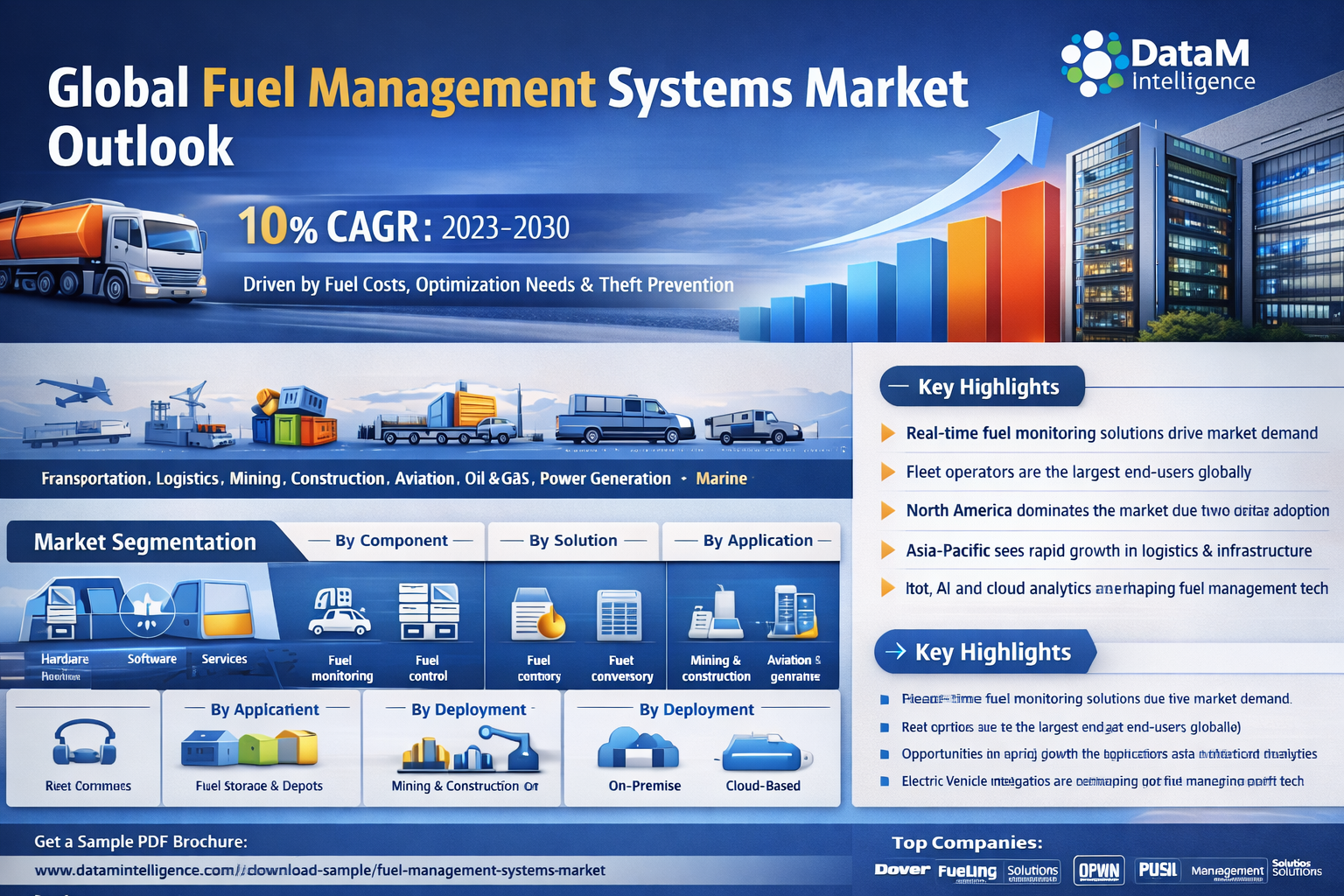
AUSTIN, TX, UNITED STATES, December 19, 2025 /EINPresswire.com/ -- According to DataM Intelligence, the global fuel management systems market is expected to grow at a CAGR of 10% during the forecast period 2023–2030. This growth is driven by increasing demand for efficient fuel utilization, rising fuel costs, and the need to reduce operational losses across industries such as transportation, logistics, mining, construction, and aviation. Organizations are increasingly adopting fuel management systems to improve monitoring, control fuel theft, optimize consumption, and ensure regulatory compliance.— DataM Intelligence
𝗚𝗲𝘁 𝗮 𝗦𝗮𝗺𝗽𝗹𝗲 𝗣𝗗𝗙 𝗕𝗿𝗼𝗰𝗵𝘂𝗿𝗲 𝗼𝗳 𝘁𝗵𝗲 𝗥𝗲𝗽𝗼𝗿𝘁 (𝗨𝘀𝗲 𝗖𝗼𝗿𝗽𝗼𝗿𝗮𝘁𝗲 𝗘𝗺𝗮𝗶𝗹 𝗜𝗗 𝗳𝗼𝗿 𝗮 𝗤𝘂𝗶𝗰𝗸 𝗥𝗲𝘀𝗽𝗼𝗻𝘀𝗲): https://www.datamintelligence.com/download-sample/fuel-management-systems-market
Fuel management systems (FMS) have become an essential component across industries that depend heavily on fuel consumption, including transportation, logistics, mining, construction, aviation, marine, oil & gas, and power generation. These systems combine hardware, software, and communication technologies to monitor, control, and optimize fuel usage across fleets, storage facilities, and distribution networks. By delivering real-time insights into fuel consumption, inventory levels, refueling activities, and theft prevention, fuel management systems help organizations reduce operational costs, improve efficiency, and ensure regulatory compliance. As fuel prices remain volatile and sustainability targets become more stringent, enterprises are increasingly adopting advanced fuel management solutions to gain better visibility and control over their fuel assets.
Key Highlights from the Report
➤ Fuel management systems are gaining traction due to rising fuel costs and operational efficiency needs.
➤ Real-time fuel monitoring solutions account for a significant share of market demand.
➤ Fleet operators are the largest end-users of fuel management systems globally.
➤ North America dominates the market due to advanced telematics adoption.
➤ Asia-Pacific is witnessing rapid growth driven by logistics and infrastructure expansion.
➤ Integration of IoT, AI, and cloud analytics is reshaping fuel management technologies.
Market Segmentation
The fuel management systems market is segmented based on component, application, end-user industry, and deployment model, reflecting diverse operational requirements across industries.
- By component, the market includes hardware, software, and services. Hardware components such as fuel sensors, flow meters, RFID readers, and control units form the foundation of fuel management systems by enabling accurate measurement and monitoring. Software solutions provide dashboards, analytics, reporting, and alerts that help organizations track consumption patterns and identify inefficiencies. Services, including installation, maintenance, and system integration, play a critical role in ensuring optimal system performance, particularly for large-scale deployments.
- By solution type, the market encompasses fuel monitoring systems, fuel control systems, and fuel inventory management systems. Fuel monitoring systems lead the segment as they offer real-time insights into fuel consumption at vehicle, equipment, and storage levels. Fuel control systems focus on preventing unauthorized access and fuel theft through access control mechanisms, while inventory management systems help organizations track fuel stock levels, replenishment schedules, and storage conditions.
- By application, fuel management systems are widely used in fleet management, fuel storage and depots, mining and construction sites, aviation and marine operations, and power generation facilities. Fleet management represents the largest application segment, driven by the growing need to optimize fuel usage across commercial vehicles, buses, trucks, and service fleets. In aviation and marine sectors, fuel management systems support safety, compliance, and cost control in fuel-intensive operations.
- By end-user industry, the market serves transportation & logistics, oil & gas, mining, construction, defense, utilities, and agriculture. Transportation and logistics dominate the market due to high fuel consumption, large fleet sizes, and increasing adoption of telematics-based solutions. The mining and construction sectors are also key adopters, using fuel management systems to monitor heavy equipment and reduce fuel wastage at remote sites.
- By deployment model, solutions are available as on-premise and cloud-based systems. Cloud-based fuel management systems are gaining preference due to scalability, remote accessibility, lower upfront costs, and seamless integration with fleet management and enterprise resource planning (ERP) platforms.
Looking For A Detailed Full Report? Get it here: https://www.datamintelligence.com/buy-now-page?report=fuel-management-systems-market
Regional Insights
- North America holds the largest share of the global fuel management systems market, driven by the presence of large fleet operators, advanced telematics infrastructure, and strict regulatory frameworks related to fuel usage and emissions. The United States leads regional growth, supported by high adoption of IoT-enabled fuel monitoring solutions across transportation, defense, and industrial sectors. Canada also contributes to market expansion through investments in smart fleet technologies and sustainable transportation initiatives.
- Europe represents a mature market characterized by strong regulatory oversight, particularly related to carbon emissions and fuel efficiency. Countries such as Germany, the UK, France, and the Netherlands are key markets, where fuel management systems are widely adopted across logistics, public transportation, and industrial operations. The region’s focus on sustainability and digitalization continues to drive demand for advanced fuel analytics and optimization tools.
- The Asia-Pacific region is the fastest-growing market for fuel management systems, fueled by rapid urbanization, expanding logistics networks, and large-scale infrastructure projects. Countries including China, India, Japan, and Australia are witnessing increased adoption of fuel management solutions as fleet sizes grow and fuel costs rise. Government initiatives promoting smart transportation and digital infrastructure further support market growth in the region.
- Latin America and the Middle East & Africa are emerging markets with significant growth potential. In these regions, fuel management systems are increasingly adopted in oil & gas operations, mining, and transportation to reduce fuel losses and improve operational transparency. Ongoing investments in logistics and energy infrastructure are expected to accelerate adoption over the forecast period.
Market Dynamics
1) Market Drivers
The primary driver of the fuel management systems market is the rising cost of fuel and the need for operational efficiency. Fuel represents one of the largest operating expenses for fleet-based and industrial operations, prompting organizations to adopt systems that provide real-time visibility and actionable insights. Additionally, the growing adoption of telematics, IoT sensors, and GPS tracking has enabled seamless integration of fuel management systems with broader fleet management platforms. Increasing regulatory pressure to reduce emissions and ensure accurate fuel reporting further accelerates market growth.
2) Market Restraints
Despite strong growth prospects, the market faces challenges such as high initial installation costs, particularly for hardware-intensive deployments. Small and medium-sized enterprises may find it difficult to justify upfront investments without clear short-term returns. Integration complexities with legacy systems and concerns related to data security and privacy can also hinder adoption, especially in highly regulated industries.
3) Market Opportunities
The market presents significant opportunities through the integration of AI, machine learning, and advanced analytics, which can enable predictive fuel consumption modeling and anomaly detection. The expansion of electric and hybrid vehicle fleets is also creating demand for next-generation energy and fuel management solutions. Furthermore, the increasing adoption of cloud-based and subscription-based models offers vendors opportunities to reach a broader customer base and deliver scalable, cost-effective solutions.
Get Customization in the report as per your requirements: https://www.datamintelligence.com/customize/fuel-management-systems-market
Reasons to Buy the Report
✔ Gain detailed insights into global and regional fuel management systems market trends.
✔ Identify high-growth segments and emerging application areas.
✔ Understand competitive strategies of leading market players.
✔ Support strategic planning with reliable market forecasts from DataM Intelligence.
✔ Make informed investment and expansion decisions with comprehensive data analysis.
Frequently Asked Questions (FAQs)
◆ How big is the global fuel management systems market?
◆ Who are the key players in the global fuel management systems market?
◆ What is the projected growth rate of the fuel management systems market?
◆ What is the market forecast for fuel management systems through 2031?
◆ Which region is estimated to dominate the fuel management systems industry during the forecast period?
Company Insights
Key players operating in the fuel management systems market include:
• Dover Fueling Solutions
• OPW Fuel Management Systems
• Piusi S.p.A.
• Franklin Fueling Systems
• Banlaw Systems
• Orpak Systems
• Technoton Engineering
• Gilbarco Veeder-Root
Recent Developments
- In November 2025, Dover Fueling Solutions expanded its intelligent fuel management portfolio with advanced cloud-based analytics solutions, backed by increased investment in digital R&D.
- In October 2025, OPW Fuel Management Systems introduced a next-generation automated fuel control platform designed to enhance theft prevention and real-time reporting for large fleet operators.
Conclusion
The fuel management systems market is poised for sustained growth as organizations worldwide seek to optimize fuel usage, reduce costs, and improve operational transparency. Supported by insights from DataM Intelligence, the market’s strong outlook through 2031 reflects increasing adoption across transportation, industrial, and energy sectors. As digital technologies such as IoT, AI, and cloud analytics continue to evolve, fuel management systems will play a crucial role in driving efficiency, sustainability, and profitability. Vendors that focus on innovation, integration, and scalable solutions will be best positioned to capitalize on the expanding global demand for intelligent fuel management.
Sai Kiran
DataM Intelligence 4market Research LLP
+ +1 877-441-4866
sai.k@datamintelligence.com
Visit us on social media:
LinkedIn
YouTube
X
Legal Disclaimer:
EIN Presswire provides this news content "as is" without warranty of any kind. We do not accept any responsibility or liability for the accuracy, content, images, videos, licenses, completeness, legality, or reliability of the information contained in this article. If you have any complaints or copyright issues related to this article, kindly contact the author above.
